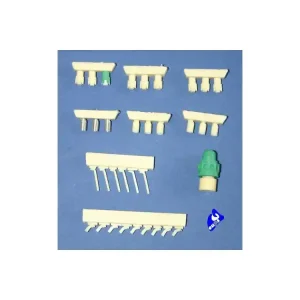

Description
Informations de base
| Code de produit | ZOU-SWS20 |
| Poids: | 1.05 kg |
| Ean | 4518992231532 |
| Échelle | 1:32 |
| Ajouté au catalogue: | 14.10.2025 |
| Tags: | Messerschmitt-Me-109 |
| Fabricant | Zoukei Mura |
| Entité responsable |
Engine, propeller, armament
The smooth, streamlined aerodynamic design that gave the Bf 109 its unique speed and agility!
The inverted-V, liquid-cooled 12-cylinder DB 605 engine has a small cross-section and a streamlined, compact fuselage shape. The inverted-V shaped cylinders allow weapons to be mounted on top of the engine to the pilot’s line of sight, improving shooting accuracy. The top of the nose section is armed with two MG 131/13.2 mm machine guns. A character-istic of the G model is the hump-like bulged cover that covers the shelling chute protruding laterally from the main body of the gun. The motor cannon that passes through the engine was replaced by the highly destructive MK 108/30 mm machine gun in some aircraft, such as the « Bf 109 G-14/U4, » but this kit uses the MG 151/20 mm machine gun that was in-stalled in early models. The SWS is a great opportunity to learn about the transition of the G-type, which boasts the largest production volume, as you assemble the kit.
Cockpit and canopy
Bf 109s unique cockpit that is neatly organized like a mass of rationalism.
In the later stages of the G-type, the Erla Haube type canopy with a small window frame was introduced to ensure the pilot’s field of vision, and the G-14 in particular adopted the late Erla Haube type with an integrated antenna mast. In addition, the G-14 was equipped with a garland panzer consisting of an 8 mm steel plate behind the seat, a 60 mm glass plate behind the windshield, a 13 mm steel plate at the bottom, and a 60 mm glass plate at the top, which improved rearward visibility. On the inside wall of the cockpit, a pipe for checking the presence or absence of fuel from the L-shaped 400-liter fuel tank installed from behind to below the cockpit extends, and the SWS kit replicates it in detail with clear parts just like the actual plane. The unique cockpit of the Bf 109, neatly organized like a mass of rationalism, also seems to show the genius of Messerschmitt.
Wing and internal structure
The Bf 109’s wings, which excelled at one-strike attacks, and their internal structure.
The Bf 109’s main wings were of the most common cantilever type, with automatic leading edge slats, and the radiator flaps, which had been enlarged since the F model, were re-placed by a clamshell type that, in addition to its flap function, also served as a cooler, allow-ing air to flow out through the radiator between the upper and lower surfaces of the wing. The flaps have been changed to a clamshell type, which also serves as a cooler. The SWS ful-ly reproduces this characteristic radiator flap with a selectable open/ mechanism. The Bf 109’s wing structure, which excels in one-strike attack and is overflowing with functional beauty, has been carefully recreated in the SWS kit.
Vertical tail wing
The G type, which boasts the largest number of production among the many sub-types, has been replicated in detail to show the wide range of differences.
The G-14 was the most produced version among the G-10 to G-16 subtypes, the last series of the G-type, which spanned a wide range of models. This kit rep-licates the G-14 in detail, which is said to have many minor differences in the shape and specifications of various parts due to its large number of pro-duction, including differences from the « U4, » which has a different armament. One of the most distinctive and significant differences is the vertical tail wing. The « Hartmann model » has a short vertical tail fin inherited from the G-6 early type, but this kit uses a large vertical tail fin inherited from the G-6 late type. This kit is a perfect start of a new era of the SWS, and we hope you will experience the functional beauty, rich details, and ease of assembly of the rare and famous Bf 109 with your own hands and eyes.
Le Messerschmitt Bf-109 est un chasseur monomoteur allemand à structure métallique dans une configuration à aile basse avec une queue classique. Il s’est avéré être le chasseur de base de la Luftwaffe et le plus produit pendant la Seconde Guerre mondiale. Le vol du prototype eut lieu le 29 mai 1935, et la production en série se poursuivit dans les années 1936-1945. Au total, on estime qu’un total d’environ 35 000 chasseurs Messerschmitt Bf-109 de toutes les variétés ont été produits, dont beaucoup se sont retrouvés dans les forces aériennes tchèques et israéliennes après la guerre. Les racines du Bf-109 remontent au concours annoncé en 1933 par la Luftwaffe pour un nouvel avion de chasse. En concurrence avec le He-112, le projet Bf-109 a d’abord perdu, mais grâce aux intrigues de Willie Messerschmitt, le projet a pu continuer et finalement il a été le vainqueur du concours, devenant le chasseur principal de la Luftwaffe. Plusieurs variantes principales du Bf-109 ont été développées au cours de la production. La première série de pré-production était le Bf-109B (Berta) avec différentes versions du moteur Junkers Jumo 210 (A ou Da). Ils ont été testés en Espagne à partir de 1937 pendant la guerre civile. La prochaine version est le Bf-109C (César). Ils avaient un moteur différent de la version B et un armement complet composé de deux canons de 20 mm et de 2 HP de 7,92 mm. Ces machines ont également combattu dans le ciel d’Espagne. La troisième version est le Bf-109D (Dora) avec le moteur Junkers Jumo 210 Da ou Daimler-Benz DB 600. Il a combattu lors de la campagne de septembre, mais au tournant de 1939/1940 il a été remplacé par la version E. Le plus Le modèle le plus célèbre était le Bf-109E (Emil) avec un moteur Daimler-Benz 601A ou N. Ce fut le premier à utiliser une hélice tripale et non bipale. Le Bf-109E a combattu dans la campagne française, au-dessus de l’Angleterre, en Afrique du Nord et sur le front de l’Est. L’as qui a commencé sa carrière sur le Bf-109E était le célèbre Adolf Galland. La version suivante est le Bf-109F (Friedrich), qui, selon les pilotes allemands, était la plus parfaite sur le plan aérodynamique. Il a semé la forme modifiée du fuselage, des ailes, des carénages de la cabine, mais aucun nouveau moteur n’a été utilisé. Il a été mis en service au tournant de 1940/1941. Dans le cadre du développement de la conception, d’autres spécifications Bf-109 ont été développées, dont la version G (Gustav) a été produite dans le plus grand nombre d’exemplaires. Le changement le plus important augmentant les performances de la machine a été l’installation d’un nouveau moteur Daimler-Benz DB605A 12 cylindres de 1475 CV. L’armement du Bf-109G était une paire de mitrailleuses de 13 mm situées dans le fuselage devant le carénage du cockpit, et le canon MG151 de 20 mm ou plus lourd MK108 de 30 mm. La dernière version produite en série était le Bf-109K (Kurfirst), dont la production a commencé en octobre 1944. Une unité Daimler-Benz DB 605DB ou DC a été utilisée comme moteur. Le Bf-109K était la version la plus rapide produite pendant la Seconde Guerre mondiale, atteignant jusqu’à 730 km/h. En dehors de cela, deux versions ont été créées – H et Z, mais il s’agissait plutôt de versions expérimentales et leur production en série n’a pas démarré. Les améliorations ultérieures de la propulsion et de l’armement ont fait du Messerschmitt Bf-109 l’un des chasseurs les plus dangereux de la Seconde Guerre mondiale, et ont en même temps montré le grand potentiel de la cellule légèrement angulaire créée par Willi Messerschmitt. Données techniques (version Bf-109 G-6) : longueur : 8,95 m, envergure : 9,92 m, hauteur : 2,6 m, vitesse maximale : 640 km/h, taux de montée : 17 m/s, portée maximale : 850 km, plafond maximum 12000m, armement : fixe – 2 mitrailleuses MG131 13mm et 1 canon MG151 20mm, suspendu – bombes 250 kg, ou 2 lance-missiles Wfr. Gr. 21.Erreur de la ? Signaler le problème