Description
Informations de base
| Code de produit | ita4716 |
| Poids: | 1.01 kg |
| Ean | 8001283047166 |
| Échelle | 1:12 |
| Ajouté au catalogue: | 18.4.2025 |
| Tags: | Bugatti-35 |
| Fabricant | Italeri |
| Entité responsable |
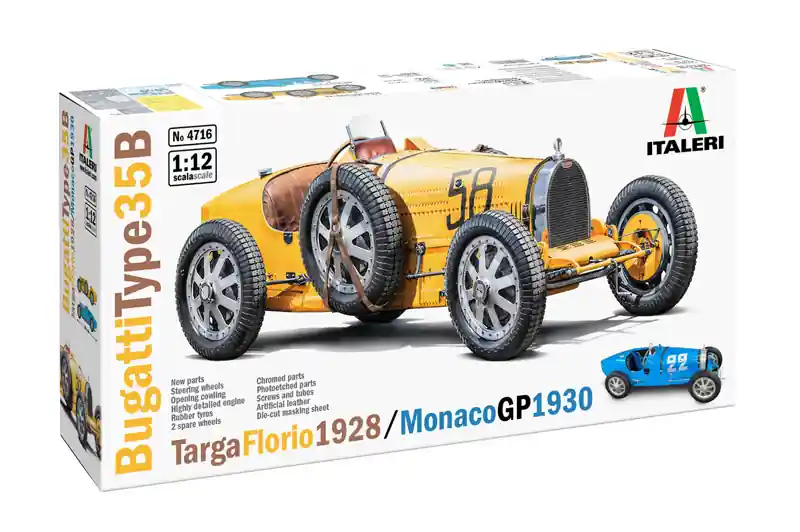
Bugatti Type 35B – Targa Florio 1928 / Monaco GP 1930
New parts – Steering wheels – Opening cowling – Highly detailed engine – Rubber tires – 2 spare wheel – Decals for 2 versions – Chromed and Photoetched parts – Screws, tubes and artificial lather – Die-cut mascking sheet – Color Instruction Sheet
Bugatti Type 35 is among the most iconic and significant cars in the history of motorsport. A masterpiece by Ettore Bugatti, it represents an outstanding blend of engineering expertise, design, elegance, lightness, and speed. Produced during the 1920s, it achieved an extraordinary number of victories in both road and track competitions. Specifically designed for the racing world, it featured technical and mechanical solutions that made it ideal for the circuits of its era. Among its notable triumphs are the 1929 Targa Florio and the 1930 Monaco Grand Prix. From an aesthetic perspective, it was distinguished by the unmistakable horseshoe-shaped radiator grille, a signature of the Bugatti brand. Powered by an 8-cylinder 2,263 cc engine paired with a four-speed manual gearbox and equipped with a supercharger, the Bugatti Type 35 was capable of reaching a top speed of 210 km/h.
La Bugatti Type 35 est une voiture de sport et de course française qui a été présentée pour la première fois au public en 1924. Sa production en série a commencé la même année et s’est poursuivie jusqu’en 1930.
La Bugatti Type 35 a été développée et mise en production en complément de l’offre commerciale de l’entreprise, mais aussi en lien avec la volonté de créer la meilleure voiture de course possible. Tout en travaillant sur le modèle 35, de nombreuses expériences ont été utilisées, ainsi que des composants prêts à l’emploi des voitures Bugatti Type 13 et Type 29. Des efforts ont également été faits pour assurer au nouveau modèle une traînée aérodynamique aussi faible que possible. Diverses unités de puissance ont été utilisées comme moteur, mais l’une des plus célèbres était le moteur de 2,2 litres avec 130 CV. Enfin, une voiture très réussie a été créée, elle était capable d’accélérer à 201 km/h, et son accélération de 0 à 100 km/h était d’environ 6-6,5 secondes ! La voiture était également plutôt fiable et tenait relativement bien sur la route. Dans la seconde moitié des années 1920, il était inégalé sur les pistes de course en Europe et a remporté plus de 1 000 courses automobiles !
Erreur de la ? Signaler le problème